
Our ZS180 received an MOT advisory. The rear axle compliance bushes were showing signs of age cracking. No problem, just a bit of graft to swap them. Ordering up a set was easy enough. Yes, they were said to be suitable for ZS180. I remembered that we hadn’t changed the bush rates from the Rover 400/45 yet there was a nagging voice reminding me of a change. But what?
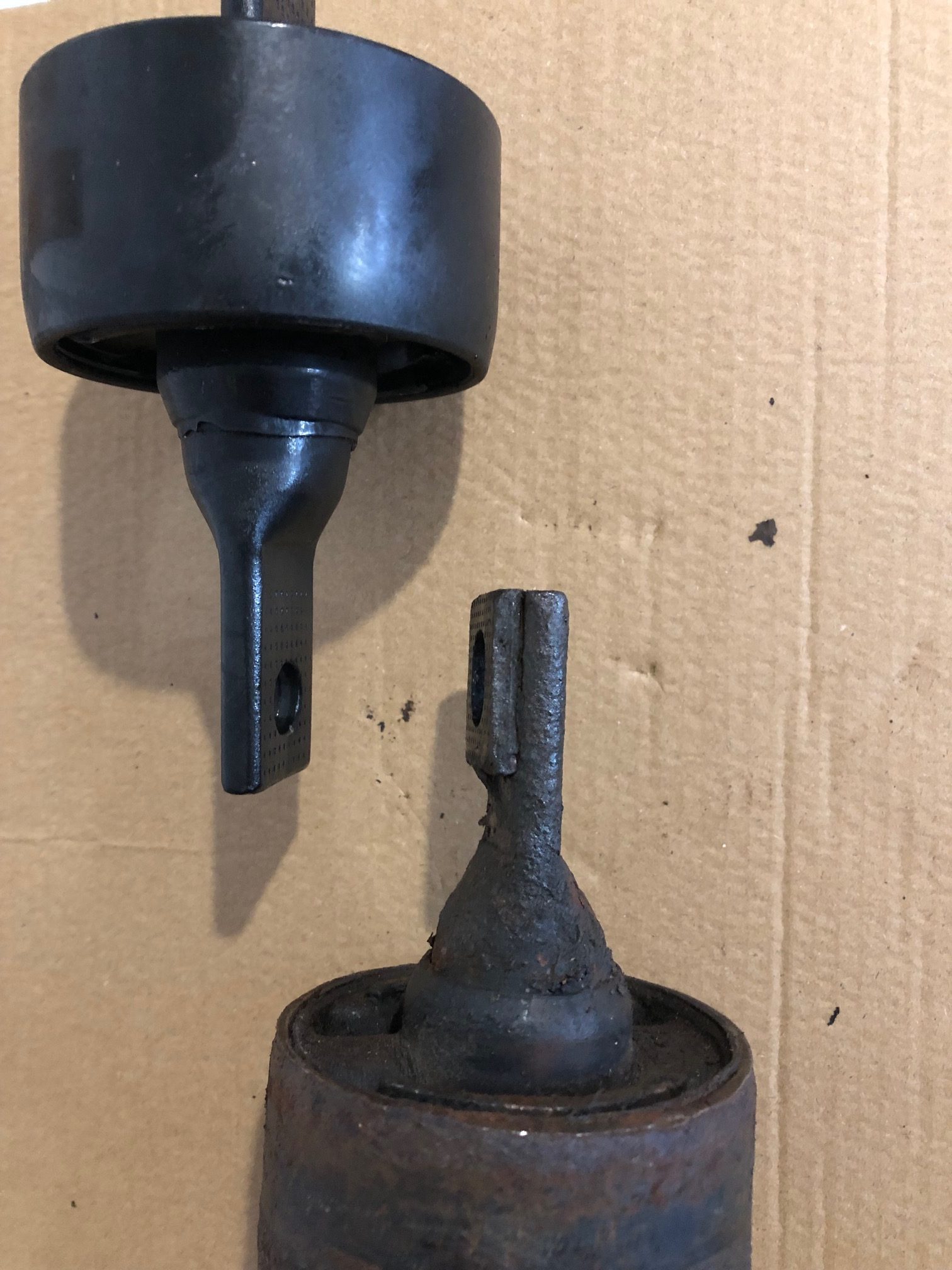
Having removed the left-hand bush and compared it to the new one, it all came back to me. High speed steer response and a few washers. Or welded on plates for the production cars, as shown in the picture.
Having worked with the BMW engineers during the latter years of the Rover Group, I had seen the benefits of checking our tuning results on the autobahn and Nuerburgring Nordschleiffe. Even the journey from Longbridge to our base in the small town of Blankenheim was revealing, be it ride comfort, refinement or steering efforts. There is nothing like a lengthy and challenging drive to focus your mind on the priorities. When we developed the MGTF and ‘Z’ cars at MG Rover, every derivative was checked and ‘signed off’ after trips to mainland Europe.
The MG ZS180 chassis tuning car was actually a Rover 45 V6 auto ‘mule’. And it was working really well, with the lowered (a key point here) and tuned suspension. Great steer response and with a willingness to change direction despite the engine up front, it had surprised many on local forays from Longbridge. But taking our downhill stretch of autobahn at maximum speed, it was arguably a bit too keen to change direction. Fine with an enthusiastic driver and 100% concentration, but what about a tired driver trying to rush home not noticing a lorry about to pull out…
What to do with only a hotel car park and a single car garage to store our tools? Well, why not measure the rear bump steer? It was a bit fiddly, using Dunlop tracking gauges and random detritus found in the garage to load the car up (in order to push the rear of the car down). I recall a pair of wheels with winter tyres, a fuel can and a bag of cement were purloined to add mass to the toolbox and spares that we had brought with us. We got a result of sorts, enough to convince us to dig out the washers and space down the compliance bush housings.
Did it work? Well, yes actually. The work was repeated in more detail back at Longbridge, but we now had a car that liked to rotate at the driver’s bidding, but with a decent safety margin to boot. So, my ZS180 now has new compliance bushes, with added spacers – donated by the old bush housings (courtesy of a quick angle grind). Good as new and working as intended. There is always a reason for change, even if it takes a while to remember it!